Kinmara · Sony FX3 · For your videographer
Your first dance only happens once.
So we film a second angle of it from the stage, and hand the footage to your videographer.
One camera, one angle, one take
Almost everything else at a wedding can be covered again from another side. The speeches run for twenty minutes. The confetti gets a second throw more often than anyone admits. Your first dance gets one attempt, in low light, with a ring of guests around it, and whatever your videographer captured in those three minutes is what exists forever.
They will have planned for it and they will almost certainly nail it. But they are one person on one side of a circle, and the things that can go wrong are the things nobody controls. A guest steps into frame. A phone goes up at the wrong moment. The light in the room turns out to be worse than it looked in the afternoon.
A second angle means none of that matters. If their shot is perfect, they have a cutaway that makes the edit better. If something went wrong, they have a way out. Either way, nobody has to find out which one it was three weeks later.
The same second, from both cameras
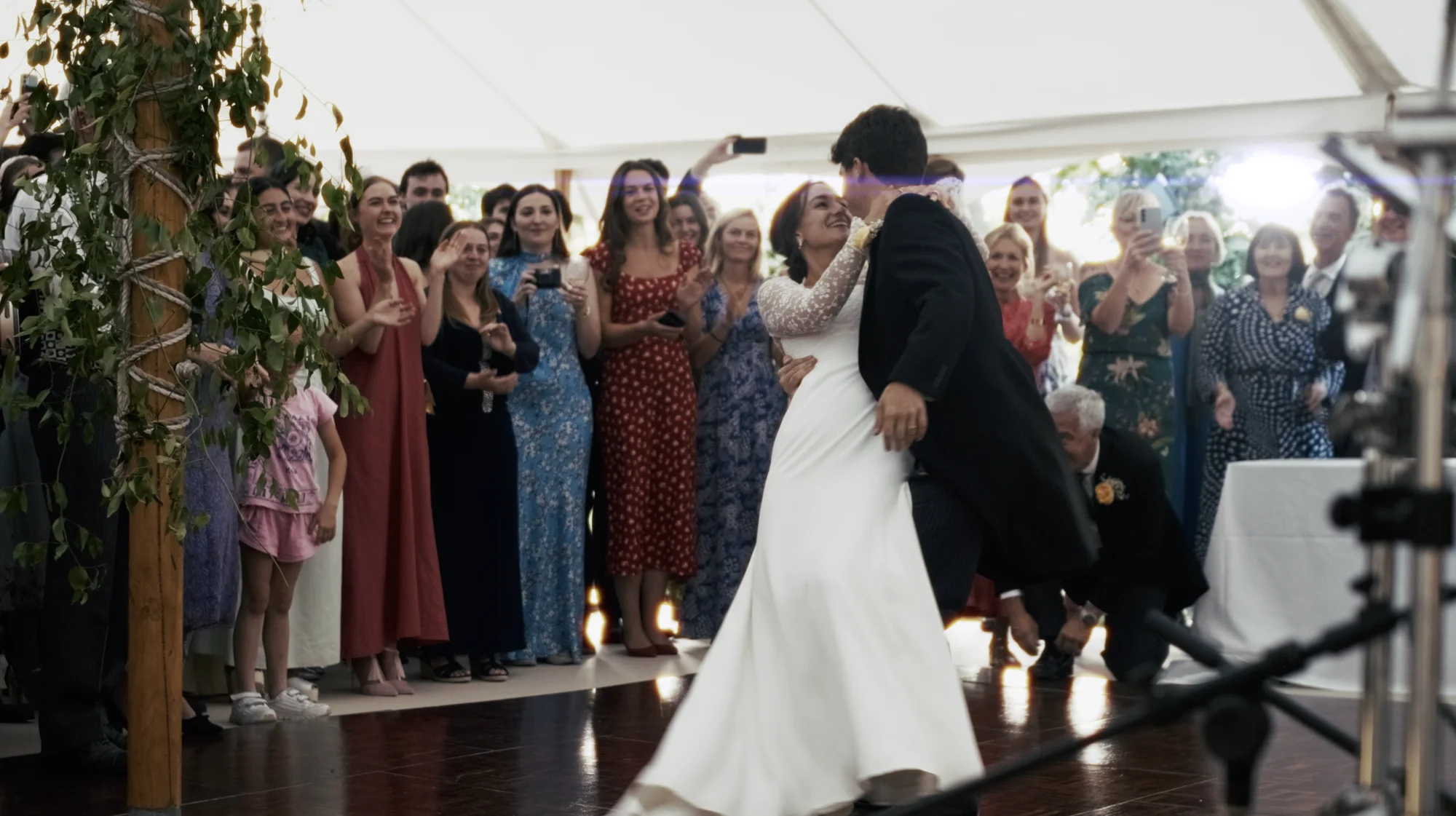
One real first dance, at the same instant, from the floor and from the stage.
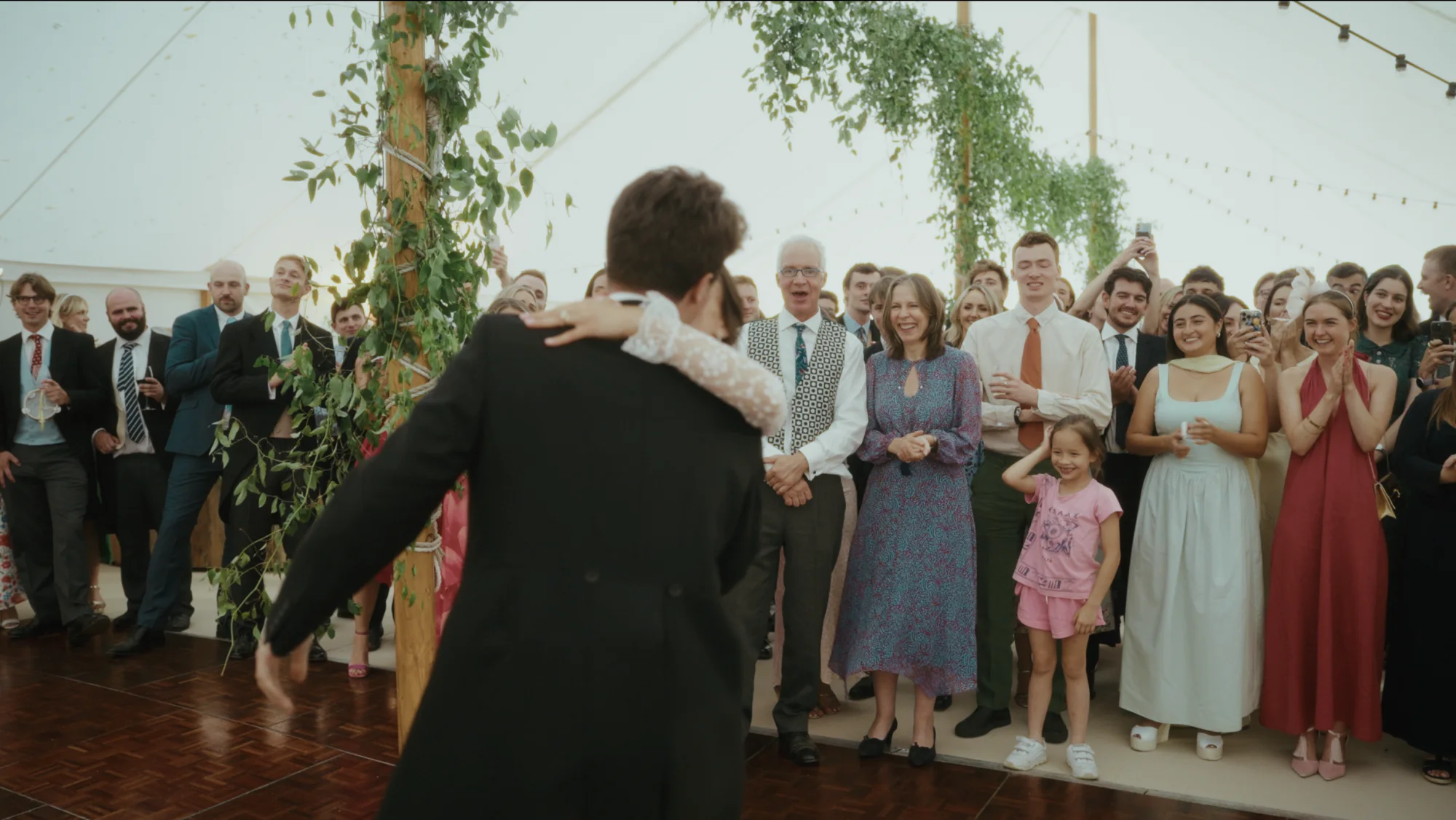
The videographer's angle
The couple turned. From here that means a back, and a bride you cannot see.
Our angle, same moment
Both faces, mid dip, and every guest in the room reacting behind them.
This is not a criticism of the videographer. He was excellent, and there was no second position he could have been standing in. A couple turning mid dance will show their back to somebody, and with one camera in the room that somebody is whoever is filming. The only fix is another angle.
And the rest of the night
The camera does not stop when the first dance does. It runs for our whole performance, which means the rest of the evening is covered from the same angle: your uncle's routine, the circle that forms around your best friend, the floor at eleven o'clock when everyone has stopped being self conscious.
A videographer at the back of the room films the backs of heads. From the stage you get the faces, and you get them for the entire set rather than the passes somebody had time to make.
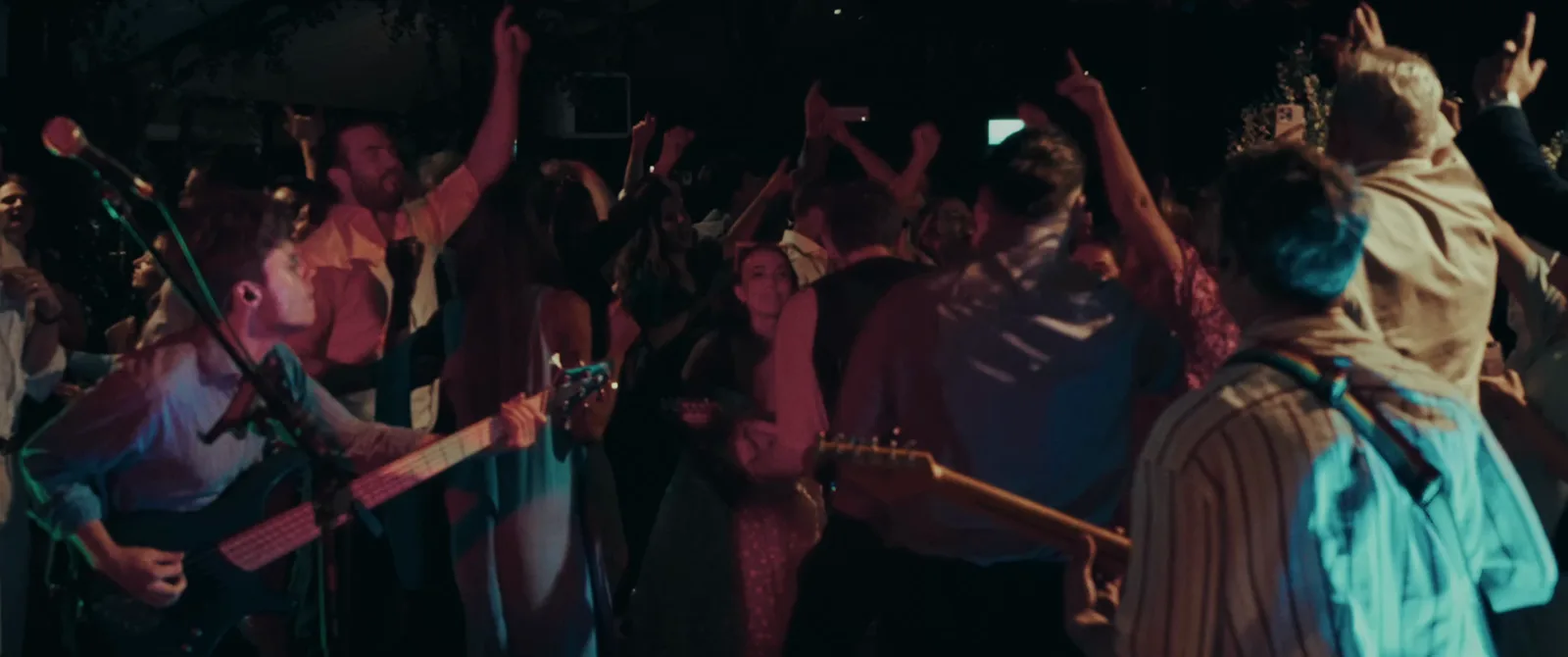
One angle, many moments.
Where it sits
On the stage, with us, looking out. Nobody else has a reason to put a camera there.
It goes up when we set up and comes down when we pack away, so there is no extra person in your room, nothing on your floor plan, and nothing for your guests to walk around.
Where exactly it goes depends on your stage. If there is room it sits up there with us, which is the angle we want. If the stage is tight, it goes as close to that position as we can get while still holding a good frame. Judging that is the part we are qualified to do, and we would rather move the camera than settle for a worse shot.
And if your videographer has something else in mind, we will happily work to it on the day. They are the one building the film, so if there is an angle they want covering more than this one, that is the one we will point at.
Because it is locked off it runs for the whole performance rather than the moments someone chose to point at. Whatever happened on that dancefloor while we were playing, it was filming.
Filmed on the same kit they are using
One of us works as a videographer, so the shot is framed by someone who does this for a living rather than pointed at the room and hoped for.
Sony FX3
A full frame cinema camera, and in most cases the same body your videographer is shooting on. Good in the dark, which matters once the lights go down.
Sigma Art 24-70mm
Wide enough for the whole floor, long enough to pick a face out of it. One lens covering the range the room actually needs.
Handed straight over
Raw footage to your videographer after the event, ungraded and uncut, so their film still looks like their film.
Why this costs a fraction of a second shooter
Booking a second videographer means booking a second person: their day, their travel, their meal, their time in the edit. It is a real cost and it is why most couples decide against it.
We are already in the room, already setting up, already there until the end. The camera is ours and it goes up alongside everything else, so the only thing you are paying for is the kit and the footage. That is the entire reason we can offer it at the price we do.
It is £250, which is a fraction of what a second shooter costs and roughly what the extra coverage is worth to us given we are standing there anyway.
Questions about the second angle
Including the ones your videographer will want answered.